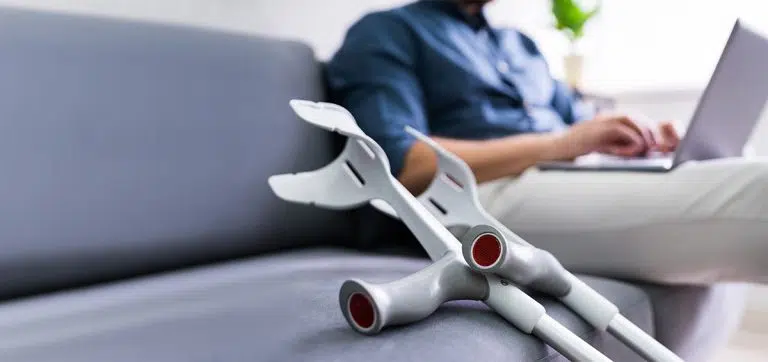

Employers in the UK are legally required to take all reasonable steps to keep their employees safe. When they fail to do so, accidents can happen – sometimes leading to serious or even life-changing injuries.
If your employer has not fulfilled their duty of care, you may be entitled to make a workplace injury compensation claim.
In this guide, we’ll explore the 10 most common injuries from work, including slips, trips and falls, manual handling accidents, and crush injuries. We will also give you information to help you understand your rights after an accident at work.
1. Slips, Trips, and Falls
Slips, trips and falls are the leading cause of workplace accidents, accounting for around 33% of non-fatal workplace injuries in the UK (according to Health and Safety Executive (HSE). These types of accidents can range from mild to life-changing.
The main causes of slips, trips and falls include wet surfaces, tripping hazards (such as exposed cables or even surfaces), poor footwear and poor lighting.
Although slips, trips, and falls can occur in any industry, certain injuries are higher risk than others. For example, construction, hospitality and manufacturing sectors may be more likely to experience slips, trips and falls than marketing businesses, for example.
If you’ve experienced a slip, trip or fall and it wasn’t your fault, book a no-obligation consultation with us today. We can help you get the compensation you deserve.
2. Manual Handling Injuries
Around 21% of all workplace injuries are caused by manual handling activities. Manual handling includes lifting, pulling, carrying or pushing heavy objects, and can lead to injuries such as:
- Pulled muscles
- Slipped discs
- Sciatica
- Musculoskeletal disorders (MSDs)
- Strains and sprains
- Hernias
- Crush injuries
It is your employer’s responsibility to adhere to regulations such as the Manual Handling Operations Regulations 1992 (MHOR) to reduce the risk of manual handling injuries. If they fail to do so and you fall victim to a manual handling injury, you could be eligible for compensation.
3. Impact From Moving Objects
10% of all non-fatal accidents in the UK are due to impact from moving objects, according to HSE Statistics 2023/24, costing the UK economy around £21.6 billion per year. Moving objects can include:
- Falling objects
- Flying objects
- Hand tools
- Moving equipment (including vehicles)
It is the responsibility of the employer to conduct regular risk assessments, provide PPE, and provide relevant training. If you have had an accident at work due to moving objects, and it wasn’t your fault, you can claim compensation. A dedicated personal injury solicitor firm like CEL Solicitors can give you the best chance of a successful claim.
4. Repetitive Strain Injuries
Repetitive strain injuries are also common workplace injuries, especially for office workers, those in healthcare, musicians and artists.
These injuries are caused by repeated movements, usually affecting the hands, arms, wrists, neck and shoulders, with symptoms ranging from mild to chronic.
Symptoms can include:
- Cramps
- Tingling
- Reduced mobility
- Aching
- Burning
- Swelling
- Loss of coordination
- Long-term disability
Under the Health and Safety at Work Act 1974, employers must conduct regular risk assessments, encourage early symptom reporting, and provide ergonomic equipment such as comfortable chairs or monitor stands. If your employer fails to address RSI, you can make a compensation claim.
5. Workplace Violence
Acts of violence at work contribute to around 7-9% of workplace injuries – especially in industries such as retail, healthcare and other public-facing sectors.
In the year 2023/24, there were 642,000 incidents of work-related violence reported in England and Wales.
Workplace violence doesn’t only include physical assault, such as punching or kicking. It can also include:
- Verbal intimidation
- Online abuse
- Bullying
- Verbal aggression
- Sexual assault
There are several routes to claim compensation for workplace violence, whether it be through your employer, through CICA or through a civil claim. To claim against your employer, they must have failed in their duty of care. For example, they may have ignored risks or lacked security measures.
6. Falls From a Height
Falls from a height are the leading cause of workplace fatalities in the UK, with this injury accounting for 36% of worker deaths in 2023/24.
If you have fallen from a height because your employer failed to comply with the Work at Height Regulations 2005, you may be eligible for compensation. Payouts can range from £1,500 to over £300,000 depending on the severity of the injury.
7. Hazardous Material Exposure
Exposure to hazardous materials can lead to burns, irritation, and long-term issues such as COPD, asthma, cancer and mesothelioma. Some common hazardous substances include:
- Asbestos
- Cleaning chemicals
- Metalwork fluids
- Welding fumes
- Silica dust
Your employer must adhere to the Control of Substances Hazardous to Health (COSHH) Regulations 2002 and the Health and Safety at Work Act 1974. If you have been injured due to hazardous materials, you can make a compensation claim.
8. Burns
Burns can occur in any working environment, whether it be construction, medical, or even offices. Some leading causes of burns at work in the UK include:
- Boiling water
- Chemicals
- Electrical faults
- Hot water
- Hot oil
- Hot wax
- Bitumen
If you’ve had a burn at work, whether it be mild or severe, you can make a claim if it was due to a lack of PPE, training, or if your employer failed to prevent hazards.
9. Vehicle Collisions
Work-related vehicle collisions were responsible for 25 deaths in 2024/24, with around 35,000 incidents causing more than 3 days’ absence. Whether it’s due to mechanical issues, lack of training, or distractions, vehicle accidents can be extremely distressing.
If your employer failed to provide adequate training, didn’t maintain the vehicles or did not implement traffic controls, you could claim compensation. We are experts at road traffic accident claims and accident at work claims, so reach out to us today to start your claim.
10. Crush Injuries
Crush injuries are caused by body parts being trapped, impacted or compressed by objects. Some leading causes of this type of injury at work include:
- Falling objects
- Vehicle accidents
- Machinery
If you have experienced a crush injury at work and your employer breached the Health and Safety at Work Act 1974 (for example, by not implementing correct training), you can make a claim.
The outcome can depend on the severity of your injury – for example, the extent of your physical harm or psychological trauma.
Ready to Make a Workplace Injury Claim?
If you have been injured at work due to unsafe conditions or employer negligence, you may be entitled to compensation.
At CEL Solicitors, we understand how stressful workplace injuries can be, and we are here to help you every step of the way. Our team specialises in accident at work claims and will make sure you understand your rights and the options available to you.
We work on a no-win, no-fee basis, so you will not have to pay anything unless your claim is successful. To speak to one of our experts, call us free on 0333 305 4982 or start your claim online today.